
Beneath the Underdog: His World as Composed by Mingus

Charles Mingus (1971)

A wild, lyrical, and anguished autobiography, in which Charles Mingus pays short shrift to the facts but plunges to the very bottom of his psyche, coming up for air only when it pleases him. He takes the reader through his childhood in Watts, his musical education by the likes of Louis Armstrong, Duke Ellington, and Charlie Parker, and his prodigious appetites–intellectual, culinary, and sexual. The book is a jumble, but a glorious one, by a certified American genius.

Posted in biography, music

Whereishere

Scott and Laurie Makela (1998)

What is driving communication and what are the real challenges facing designers today? Whereishere presents a radical new take on both these issues, breaks from the orthodox approach to understanding two dimensional design. Leading graphic design studios are represented including Bruce Mau and Cranbrook Academy of Art.

Posted in art, Cranbrook, design, education, media, photography, typography

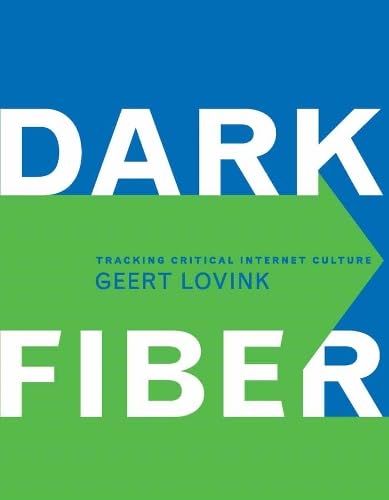
Dark Fiber: Tracking Critical Internet Culture

Geert Lovink (2002)

In Dark Fiber, Lovink combines aesthetic and ethical concerns and issues of navigation and usability without ever losing sight of the cultural and economic agendas of those who control hardware, software, content, design, and delivery. He examines the unwarranted faith of the cyber-libertarians in the ability of market forces to create a decentralized, accessible communication system. He studies the inner dynamics of hackers’ groups, Internet activists, and artists, seeking to understand the social laws of online life. Finally, he calls for the injection of political and economic competence into the community of freedom-loving cyber-citizens, to wrest the Internet from corporate and state control.

Posted in culture, media, politics, technology

Mixing Messages

Ellen Lupton (1996)

How do we disseminate information? And what does it look like? Ellen Kupton answers that in her new book, Mixing Messages: Graphic Design in Contemporary Culture. Lupton looks at the mission of design through discussions about publishing, signage, typography, corporate identity and the use of design in public places. Mixing Messages will fascinate fans of design, culture or social history.

Posted in art, culture, design, media, semiotics, typography

Sign Wars: The Cluttered Landscape of Advertising

Robert Goldman and Stephen Papson (1996)

Contemporary ads are a symbol of competition as much as a bid for new customers: that’s the contention of authors who suggest that the “sign wars” represent a consequence of a disjoined media culture. Insights on media, advertising strategy, and business blend in a strong consideration which uses signs and symbols from recent campaigns to provide a critical view of ad culture results.

Posted in culture, language, media, semiotics, theory

Ways of Seeing

John Berger (1972)

John Berger’s, The Ways of Seeing, based on the groundbreaking BBC television series of the same name, challenges us to rethink the ways in which we view the world and the many images that surround it. Every image that confronts us embodies a way of seeing (i.e. the photographer’s, the painter’s, etc) but it is the way in which we see that image – the perspective of the beholder – that is of especial interest to Berger. Before the invention of the camera, which ushered in an “age of reproduction,” the spectator’s perspective in relation to the work of art was dominant. Now, instead of the “spectator traveling to the image” the “image travels to the spectator.” Through the means of reproduction, the meaning of art was indelibly changed.

Posted in art, culture, media, semiotics, theory

The Poetics of Space

Gaston Bachelard (1964)

The classic book on how we experience intimate spaces. A magical book. A prism through which all worlds from literary creation to housework to aesthetics to carpentry take on enhanced—and enchanted-significances. Every reader of it will never see ordinary spaces in ordinary ways. Instead the reader will see with the soul of the eye, the glint of Gaston Bachelard.

Posted in architecture, art, consciousness, language, philosophy

A Natural History of the Senses

Diane Ackerman (1990)

An exciting multidiscipline book that crosses the lines of literature, history, anthropology, music, psychology, sociology, and philosophy and that flows with grace and reason. The theme is expressed in such a way as to draw readers into experiential thought and, therefore, impacts heavily upon the way one looks at the issue of sensing and its role for humanity. It is sure to raise readers’ consciousness level while providing researched and analyzed information on this topic. In addition, the language is clear and concise, which makes the book valuable to a large cross section of readers. The generous use of cultural and historical examples adds to the readability.

Posted in consciousness, history, language, music, philosophy, science

A Pictorial History of Psychology

Edited by Wolfgang G. Bringmann (1997)

Compendium of 107 historical essays and illustrations. Expanded version of a translated German title (1993). Includes 50 new English language essays.

Posted in consciousness, history, psychology, science

Being There: Putting Brain, Body, and World Together Again

Andy Clark (1996)

Brain, body, and world are united in a complex dance of circular causation and extended computational activity. In Being There, Andy Clark weaves these several threads into a pleasing whole and goes on to address foundational questions concerning the new tools and techniques needed to make sense of the emerging sciences of the embodied mind. Clark brings together ideas and techniques from robotics, neuroscience, infant psychology, and artificial intelligence. He addresses a broad range of adaptive behaviors, from cockroach locomotion to the role of linguistic artifacts in higher-level thought.

Posted in consciousness, language, science, technology