
Category Archives: science
The New Media Reader
 Edited by Noah Wardrip-Fruin and Nick Montfort (2003)
This reader collects the texts, videos, and computer programs–many of them now almost impossible to find–that chronicle the history and form the foundation of the still-emerging field of new media. General introductions by Janet Murray and Lev Manovich, along with short introductions to each of the texts, place the works in their historical context and explain their significance. The texts were originally published between World War II–when digital computing, cybernetic feedback, and early notions of hypertext and the Internet first appeared–and the emergence of the World Wide Web–when they entered the mainstream of public life.
Posted in art, history, media, philosophy, science, technology, theory
Multimedia: From Wagner to Virtual Reality
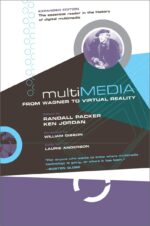 Edited by Randall Packer and Ken Jordan (expanded edition, 2002)
Readers interested in the history of multimedia should be enthralled by this collection of hard-to-find essays. “Outline of the Artwork of the Future,” for instance, was first published in 1849, and its author was the great German composer Richard Wagner, who envisioned a new kind of stage drama that united music, visual effects, poetry, and dance. Skip forward seven decades, and here’s 1924’s “Theater, Circus, Variety,” by Laszlo Moholy-Nagy, one of the foremost practitioners of the Bauhaus school of art. His elaboration of Wagner’s ideas incorporated the revolutionary idea of removing the so-called fourth wall and involving the audience in the play. Similarly, these essays trace the evolution of electronic media, film, and books (William Burroughs’ 1964 piece, “The Future of the Novel,” is itself worth the price of admission). A remarkable blending of past and present, these essays remind us that today’s wondrous inventions didn’t just spring into existence out of nothingness.
Posted in art, history, media, philosophy, science, technology, theory
Searchlight: Consciousness at the Millennium
 Edited by Lawrence Rinder (1999)
This book is an unprecedented exploration of the nature of consciousness and its embodiment in many forms of contemporary art including painting, sculpture, installation, video, film, and computer media. At what is possibly the most portentous moment in recent history–the turn of the millennium–Searchlight reveals the threads of a new aesthetic, reaching from the early nineteenth century through its extraordinary fulfillment in the art of the present. Consciousness is the bedrock of all experience, the foundation of all perception and interaction, the source of meaning. As such, it may be said to have been the primary subject of art for the past 125 years, ever since the Modernist revolution of the nineteenth century shifted artists’ goals from the direct representation of the seen world to the expression of felt experience. As art increasingly focused on the perceiver rather than the perceived, the consciousness of the artist and the viewer moved to the foreground of the artistic event.
Posted in art, consciousness, exhibition, philosophy, science, theory
A Thousand Years of Nonlinear History
 Manuel De Landa (1997)
De Landa attacks three domains that have given shape to human societies: economics, biology, and linguistics. In every case, what one sees is the self-directed processes of matter and energy interacting with the whim and will of human history itself to form a panoramic vision of the West free of rigid teleology and naive notions of progress, and even more important, free of any deterministic source of its urban, institutional, and technological forms. Rather, the source of all concrete forms in the West’s history are shown to derive from internal morphogenetic capabilities that lie within the flow of matter-energy itself.
Posted in consciousness, history, language, philosophy, science, theory