
Category Archives: history
Prints and Visual Communication
 William Ivins (1969)
The sophistication of the photographic process has had two dramatic results–freeing the artist from the confines of journalistic reproductions and freeing the scientist from the unavoidable imprecision of the artist’s prints. So released, both have prospered and produced their impressive nineteenth- and twentieth-century outputs. It is this premise that William M. Ivins, Jr., elaborates in Prints and Visual Communication, a history of printmaking from the crudest wood block, through engraving and lithography, to Talbot’s discovery of the negative-positive photographic process and its far reaching consequences.
Posted in art, history, media, photography, printmaking, technology
Juniper Fuse: Upper Paleolithic Imagination and the Construction of the Underworld
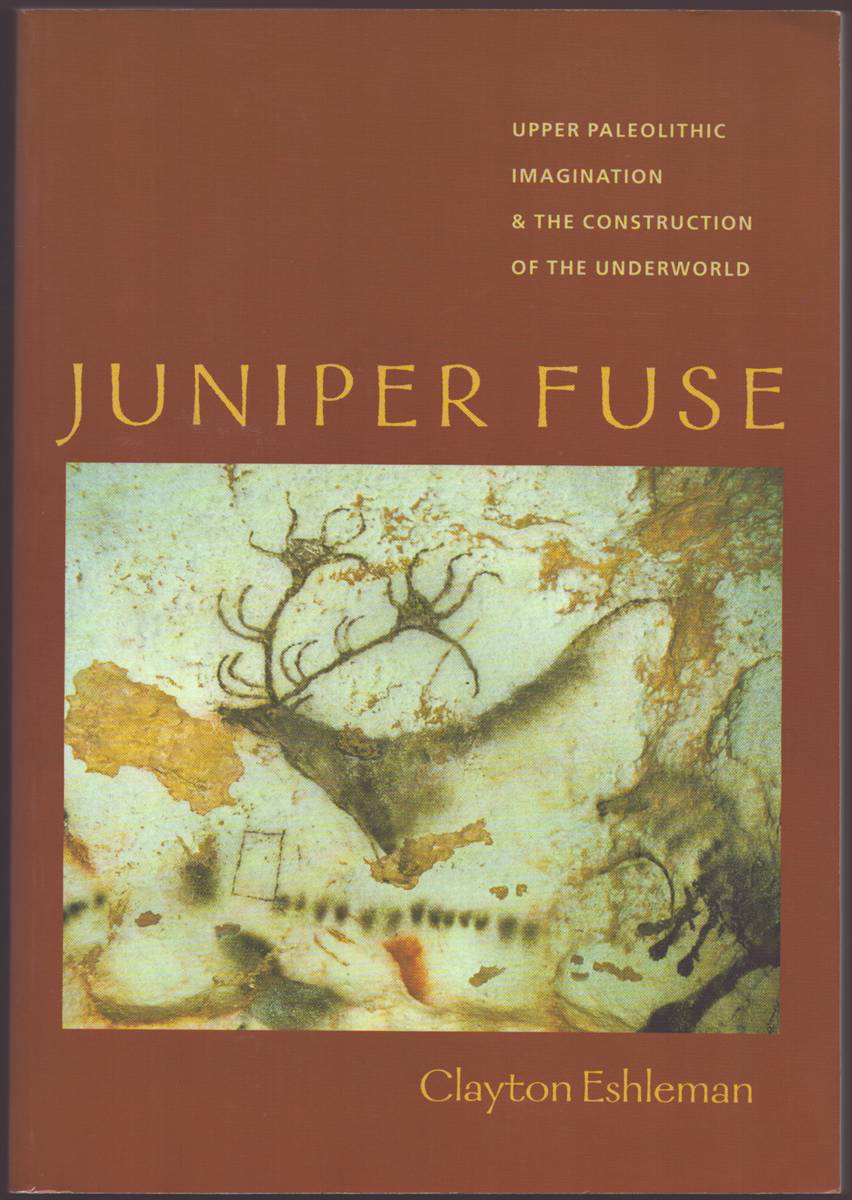 Clayton Eshleman (2003)
This arresting diptych of verse and philosophical prose charts a twenty-five-year obsession with the prehistoric cave paintings of southwestern France. The region’s enigmatic art work, dating from the Upper Paleolithic era, has been a constant muse for Eshleman, whose wildly discursive style mirrors the superimposed scenes of animal herds and shamanistic figures that populate the cave walls. Breathless accounts of cave exploration appear in counterpoint with poems in eerily primordial voices. Although his thesis that all art results from the separation anxiety between human and animal is unpersuasive, there is an impressive exuberance to his efforts to trace back to this common source everything from Greek myth to Allen Ginsberg. For Eshleman, it seems, the artist’s imaginative predicament is something of a cave itself, both maze and refuge.
Posted in art, consciousness, history, philosophy, poetry
The New Media Reader
 Edited by Noah Wardrip-Fruin and Nick Montfort (2003)
This reader collects the texts, videos, and computer programs–many of them now almost impossible to find–that chronicle the history and form the foundation of the still-emerging field of new media. General introductions by Janet Murray and Lev Manovich, along with short introductions to each of the texts, place the works in their historical context and explain their significance. The texts were originally published between World War II–when digital computing, cybernetic feedback, and early notions of hypertext and the Internet first appeared–and the emergence of the World Wide Web–when they entered the mainstream of public life.
Posted in art, history, media, philosophy, science, technology, theory
Multimedia: From Wagner to Virtual Reality
 Edited by Randall Packer and Ken Jordan (expanded edition, 2002)
Readers interested in the history of multimedia should be enthralled by this collection of hard-to-find essays. “Outline of the Artwork of the Future,” for instance, was first published in 1849, and its author was the great German composer Richard Wagner, who envisioned a new kind of stage drama that united music, visual effects, poetry, and dance. Skip forward seven decades, and here’s 1924’s “Theater, Circus, Variety,” by Laszlo Moholy-Nagy, one of the foremost practitioners of the Bauhaus school of art. His elaboration of Wagner’s ideas incorporated the revolutionary idea of removing the so-called fourth wall and involving the audience in the play. Similarly, these essays trace the evolution of electronic media, film, and books (William Burroughs’ 1964 piece, “The Future of the Novel,” is itself worth the price of admission). A remarkable blending of past and present, these essays remind us that today’s wondrous inventions didn’t just spring into existence out of nothingness.
Posted in art, history, media, philosophy, science, technology, theory
A Thousand Years of Nonlinear History
 Manuel De Landa (1997)
De Landa attacks three domains that have given shape to human societies: economics, biology, and linguistics. In every case, what one sees is the self-directed processes of matter and energy interacting with the whim and will of human history itself to form a panoramic vision of the West free of rigid teleology and naive notions of progress, and even more important, free of any deterministic source of its urban, institutional, and technological forms. Rather, the source of all concrete forms in the West’s history are shown to derive from internal morphogenetic capabilities that lie within the flow of matter-energy itself.
Posted in consciousness, history, language, philosophy, science, theory
Enchanting Modern: Ilonka Karasz
 Ashley Callahan (2003)
Ilonka Karasz’s career spanned several decades and media, including textiles, furniture, ceramics, wallpaper, and graphic design. She produced over 150 covers for The New Yorker. Enchanting Modern: Ilonka Karasz (1896-1981) is the first book dedicated to the life and work of the artist.
Posted in art, biography, design, exhibition, history