
Category Archives: theory
Overlay
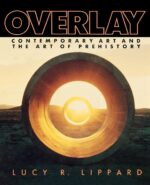 Lucy Lippard (1983)
Overlay is Lucy Lippard’s classic book on contemporary art and its connection to prehistoric sites and symbols. Viewed by critics, artists, art historians, and students as the essential text on how prehistoric images have been “overlayed” onto contemporary art by today’s artists, Overlay is for anyone interested in the possibility of reintegrating art into the fabric of society as a whole, as in prehistoric times.
Imagining Language
Version 1.0.0Edited by Jed Rasula and Steve McCaffery (1998)
When works such as Finnegans Wake and Tender Buttons were first introduced, they went so far beyond prevailing linguistic standards that they were widely considered “unreadable,” if not scandalous. Jed Rasula and Steve McCaffery take these and other examples of twentieth-century avant-garde writing as the starting point for a collection of writings that demonstrates a continuum of creative conjecture on language from antiquity to the present. The result is more laboratory than inventory. The anthology, which spans three millennia, generally bypasses chronology in order to illuminate unexpected congruities between seemingly discordant materials. Thus the juxtaposition of Marcel Duchamp and Jonathan Swift, of Victor Hugo and Easter Island “rongo rongo.”
Literary Theory
 Terry Eagleton (1983/1996)
This classic work, whose first edition sold more than 120,000 copies, is designed to cover all of the major movements in literary studies in this century. The second edition contains a major new survey chapter that addresses developments since the book’s original publication in 1983, including feminist theory, postmodernism, poststructuralism-what is broadly referred to as cultural theory.
Posted in culture, language, philosophy, semiotics, theory
The Book of Probes
 Marshall McLuhan (2003)
Until now, no book has explored the full expanse of Marshall McLuhan’s thinking. Here we have assembled alongside his most prescient aphorisms excerpts from the full range of his astounding life’s work. One revolutionary book distills the wisdom and wit of the man who explained to us the “the medium is the message” and that we are “now living in a global village”, that “privacy invasion is now our most important knowledge industry” and that “obsolescence is the moment of superabundance”. Art director and designer David Carson presents McLuhan’s images with new insight, and has built a work of art that is reminiscent of those lasting works permanently commissioned and interpreted by new generations.
Posted in culture, design, media, philosophy, technology, theory
The Paul Virilio Reader
 Edited by Steve Redhead (2004)
The Paul Virilio Reader collects for the first time English extracts reflecting the entire range of Virilio’s diverse career. The book’s introduction demonstrates that Virilio has produced an important — if controversial — “theory at the speed of light” that uncannily illuminates the impact of new information and communications technologies in a world that collapses time and distance as never before. The inventor of “dromology,” which views speed as a defining concept for contemporary civilization, Virilio is noted for his proclamation that the logic of ever-increasing acceleration lies at the heart of the organization and transformation of the contemporary world.
Posted in architecture, culture, philosophy, technology, theory
The New Media Reader
 Edited by Noah Wardrip-Fruin and Nick Montfort (2003)
This reader collects the texts, videos, and computer programs–many of them now almost impossible to find–that chronicle the history and form the foundation of the still-emerging field of new media. General introductions by Janet Murray and Lev Manovich, along with short introductions to each of the texts, place the works in their historical context and explain their significance. The texts were originally published between World War II–when digital computing, cybernetic feedback, and early notions of hypertext and the Internet first appeared–and the emergence of the World Wide Web–when they entered the mainstream of public life.
Posted in art, history, media, philosophy, science, technology, theory
Snap to Grid: A User’s Guide to Digital Arts, Media, and Cultures
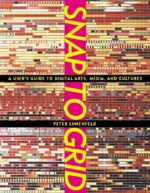 Peter Lunenfeld (2000)
In Snap to Grid, an idiosyncratic guide to the interactive, telematic era, Peter Lunenfeld maps out the trajectories that digital technologies have traced upon our cultural imaginary. His clear-eyed evaluation of new media includes an impassioned discussion–informed by the discourses of technology, aesthetics, and cultural theory–of the digital artists, designers, and makers who matter most. “Snap to grid” is a command that instructs the computer to take hand-drawn lines and plot them precisely in Cartesian space. Users regularly disable this function the moment they open an application because the gains in predictability and accuracy are balanced against the losses of ambiguity and expressiveness. Lunenfeld uses “snap to grid” as a metaphor for how we manipulate and think about the electronic culture that enfolds us. In this book he snaps his seduction by the machine to the grid of critical thinking.
Posted in art, culture, media, technology, theory
Multimedia: From Wagner to Virtual Reality
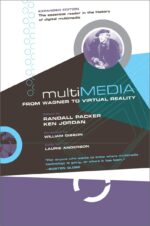 Edited by Randall Packer and Ken Jordan (expanded edition, 2002)
Readers interested in the history of multimedia should be enthralled by this collection of hard-to-find essays. “Outline of the Artwork of the Future,” for instance, was first published in 1849, and its author was the great German composer Richard Wagner, who envisioned a new kind of stage drama that united music, visual effects, poetry, and dance. Skip forward seven decades, and here’s 1924’s “Theater, Circus, Variety,” by Laszlo Moholy-Nagy, one of the foremost practitioners of the Bauhaus school of art. His elaboration of Wagner’s ideas incorporated the revolutionary idea of removing the so-called fourth wall and involving the audience in the play. Similarly, these essays trace the evolution of electronic media, film, and books (William Burroughs’ 1964 piece, “The Future of the Novel,” is itself worth the price of admission). A remarkable blending of past and present, these essays remind us that today’s wondrous inventions didn’t just spring into existence out of nothingness.
Posted in art, history, media, philosophy, science, technology, theory
The Language of New Media
 Lev Manovich (2001)
In this book Lev Manovich offers the first systematic and rigorous theory of new media. He places new media within the histories of visual and media cultures of the last few centuries. He discusses new media’s reliance on conventions of old media, such as the rectangular frame and mobile camera, and shows how new media works create the illusion of reality, address the viewer, and represent space. He also analyzes categories and forms unique to new media, such as interface and database.
Manovich uses concepts from film theory, art history, literary theory, and computer science and also develops new theoretical constructs, such as cultural interface, spatial montage, and cinegratography. The theory and history of cinema play a particularly important role in the book. Among other topics, Manovich discusses parallels between the histories of cinema and of new media, digital cinema, screen and montage in cinema and in new media, and historical ties between avant-garde film and new media.
Posted in art, cinema, media, technology, theory
Searchlight: Consciousness at the Millennium
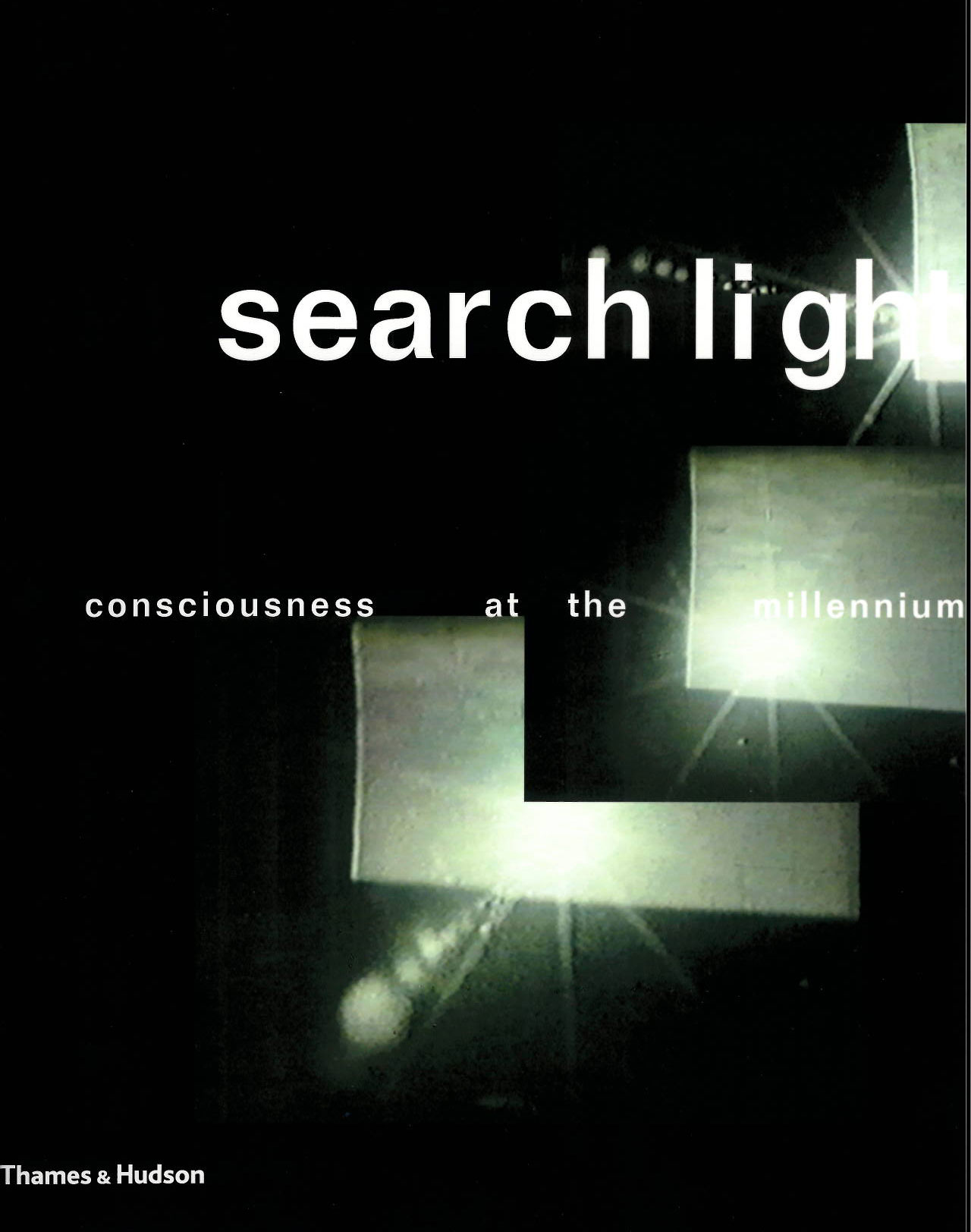 Edited by Lawrence Rinder (1999)
This book is an unprecedented exploration of the nature of consciousness and its embodiment in many forms of contemporary art including painting, sculpture, installation, video, film, and computer media. At what is possibly the most portentous moment in recent history–the turn of the millennium–Searchlight reveals the threads of a new aesthetic, reaching from the early nineteenth century through its extraordinary fulfillment in the art of the present. Consciousness is the bedrock of all experience, the foundation of all perception and interaction, the source of meaning. As such, it may be said to have been the primary subject of art for the past 125 years, ever since the Modernist revolution of the nineteenth century shifted artists’ goals from the direct representation of the seen world to the expression of felt experience. As art increasingly focused on the perceiver rather than the perceived, the consciousness of the artist and the viewer moved to the foreground of the artistic event.
Posted in art, consciousness, exhibition, philosophy, science, theory