
Category Archives: theory
The Anti-Aesthetic: Essays on Postmodern Culture
 Edited by Hal Foster (1993)
A handsome new edition of the seminal collection of late-twentieth-century cultural criticism. Named a Best Book of the Year by the Village Voice and considered a bible of contemporary cultural criticism, The Anti-Aesthetic is reissued now in a handsome new paperback edition. For the past twenty years, Hal Foster has pushed the boundaries of cultural criticism, establishing a vantage point from which the seemingly disparate agendas of artists, patrons, and critics have a telling coherence. In The Anti-Aesthetic, preeminent critics such as Jean Baudrillard, Rosalind Krauss, Fredric Jameson, and Edward Said consider the full range of postmodern cultural production, from the writing of John Cage, to Cindy Sherman’s film stills, to Barbara Kruger’s collages. With a redesigned cover and a new afterword that situates the book in relation to contemporary criticism, The Anti-Aesthetic provides a strong introduction for newcomers and a point of reference for those already engaged in discussions of postmodern art, culture, and criticism.
Forest Of Signs: Art in the Crisis of Representation
 Ann Goldstein, Mary Jane Jacob, Anne Rorimer, Howard Singerman, and Richard Koshalek (1989)
The thread of representation ties together the work of the 30 artists included in the book, encompassing such issues as allegory, appropriation, and commodification, the role of the artist, and the functions of authorship and originality in vesting meaning in art. Much of the work is provocative, challenging the way we look at art, the way we talk about it, where we see it, and how we buy it.
Posted in art, culture, exhibition, history, language, photography, semiotics, theory
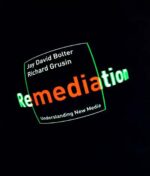
Remediation: Understanding New Media
 Jay David Bolter and Richard Grusin (2000)
Media critics remain captivated by the modernist myth of the new: they assume that digital technologies such as the World Wide Web, virtual reality, and computer graphics must divorce themselves from earlier media for a new set of aesthetic and cultural principles. In this richly illustrated study, Jay David Bolter and Richard Grusin offer a theory of mediation for our digital age that challenges this assumption. They argue that new visual media achieve their cultural significance precisely by paying homage to, rivaling, and refashioning such earlier media as perspective painting, photography, film, and television. They call this process of refashioning “remediation,” and they note that earlier media have also refashioned one another: photography remediated painting, film remediated stage production and photography, and television remediated film, vaudeville, and radio.
Posted in art, media, technology, theory
On the Passage of a Few People Through a Rather Brief Moment in Time
 Edited by Elisabeth Sussman (1989)
These photographs, essays, drawings, and original texts document the rich agit-art legacy of the Situationist International, a group of European artists and writers who emerged from such avant-garde movements as COBRA, Lettrisme, and the Imaginary Bauhaus and from the breakup of surrealism to launch a strategy of art as cultural critique.
Posted in art, history, situationist, theory
Telematic Embrace: Visionary Theories of Art, Technology, and Consciousness by Roy Ascott
 Edited by Edward Shanken (2003)
Long before e-mail and the Internet permeated society, Roy Ascott, a pioneering British artist and theorist, coined the term “telematic art” to describe the use of online computer networks as an artistic medium. In Telematic Embrace Edward A. Shanken gathers, for the first time, an impressive compilation of more than three decades of Ascott’s philosophies on aesthetics, interactivity, and the sense of self and community in the telematic world of cyberspace. This book explores Ascott’s ideas on how networked communication has shaped behavior and consciousness within and beyond the realm of what is conventionally defined as art.
Posted in art, consciousness, education, media, science, technology, theory
Lipstick Traces: A Secret History of the 20th Century
 Greil Marcus (1989)
Acclaimed rock reviewer/author Marcus offers up a fascinating thesis: that modern consciousness is to a great extent shaped by events or documents “insignificant” of themselves but collectively very important indeed, perhaps even definitive. While spending much of its time on the impact of the Sex Pistols, this is not purely a “rock-music” book–along the way one encounters various ranters, Dadaists, nihilists, whatever–even Theodore Dreiser. If it lacks the rigor demanded of academic historiography, Marcus’s book is still great popular culture, and academic historians would do well to be interested. Meanwhile, the cross-referential treatment gives a seeming (at least) validity that sheer facts wouldn’t to the idea of a “secret history” that permeates unobtrusively and yields more meaning than many would like to believe.
The Chalice and the Blade
 Riane Eisler (1994)
Women played leading roles in the first Christian communities; Jesus’ teachings had a feminist bent; ancient Hebrews worshipped the prehistoric goddess-mother well into monarchic times; and Nazis, with their system of male dominance, were a direct throwback to the Indo-European or Aryan invaders whom they crudely imitated. These controversial ideas and findings suggest the thrust of Eisler’s highly readable synthesis. She convincingly documents the global shift from egalitarian to patriarchal societies, interweaving new archeological evidence and feminist scholarship. In her scenario, as women, once venerated, were degraded to pawns controlled by men, social cooperation gave way to reliance on violence, hierarchy and authoritarianism.
Sexual Politics
Version 1.0.0Edited by Amelia Jones (1996)
Completing a trilogy begun with Chicago’s Beyond the Flower and The Dinner Party, this volume is the actual catalog of the reappearance of Chicago’s peripatetic icon of feminist art. But “The Dinner Party” is only one of about 100 other feminist artworks, created by 55 women artists, that were put on display at the Armand Hammar Museum to bring 1970s feminist art into perspective.
Posted in art, exhibition, history, theory
Meditations On a Hobby Horse and Other Essays On the Theory of Art
 E.H. Gombrich (1963)
Prompted by modern critical discussions, the fourteen papers, lectures and articles assembled in this volume revolve around issues raised by twentieth-century art and theory. Taking abstraction and expression as his main themes, Professor Gombrich’s essays encompass the whole of the history of art, and include major articles on the social history of art, visual metaphor, tradition and expression, and psychoanalysis.
Art Subjects
 Howard Singerman (1999)
Nearly every artist under the age of fifty in the United States today has a Master of Fine Arts degree. Howard Singerman’s thoughtful study is the first to place that degree in its proper historical framework and ideological context. Arguing that where artists are trained makes a difference in the forms and meanings they produce, he shows how the university, with its disciplined organization of knowledge and demand for language, played a critical role in the production of modernism in the visual arts. Now it is shaping what we call postmodernism: like postmodernist art, the graduate university stresses theory and research over manual skills and traditional techniques of representation.
Singerman, who holds an M.F.A. in sculpture as well as a Ph.D. in Visual and Cultural Studies, is interested in the question of the artist as a “professional” and what that word means for and about the fashioning of artists. He begins by examining the first campus-based art schools in the 1870s and goes on to consider the structuring role of women art educators and women students; the shift from the “fine arts” to the “visual arts”; the fundamental grammar of art laid down in the schoolroom; and the development of professional art training in the American university. Singerman’s book reveals the ways we have conceived of art in the past hundred years and have institutionalized that conception as atelier activity, as craft, and finally as theory and performance.