
Category Archives: art
Mixing Messages
 Ellen Lupton (1996)
How do we disseminate information? And what does it look like? Ellen Kupton answers that in her new book, Mixing Messages: Graphic Design in Contemporary Culture. Lupton looks at the mission of design through discussions about publishing, signage, typography, corporate identity and the use of design in public places. Mixing Messages will fascinate fans of design, culture or social history.
Ways of Seeing
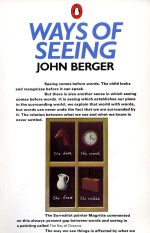 John Berger (1972)
John Berger’s, The Ways of Seeing, based on the groundbreaking BBC television series of the same name, challenges us to rethink the ways in which we view the world and the many images that surround it. Every image that confronts us embodies a way of seeing (i.e. the photographer’s, the painter’s, etc) but it is the way in which we see that image – the perspective of the beholder – that is of especial interest to Berger. Before the invention of the camera, which ushered in an “age of reproduction,” the spectator’s perspective in relation to the work of art was dominant. Now, instead of the “spectator traveling to the image” the “image travels to the spectator.” Through the means of reproduction, the meaning of art was indelibly changed.
The Poetics of Space
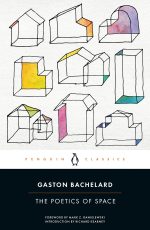 Gaston Bachelard (1964)
The classic book on how we experience intimate spaces. A magical book. A prism through which all worlds from literary creation to housework to aesthetics to carpentry take on enhanced—and enchanted-significances. Every reader of it will never see ordinary spaces in ordinary ways. Instead the reader will see with the soul of the eye, the glint of Gaston Bachelard.
Posted in architecture, art, consciousness, language, philosophy
Illuminations
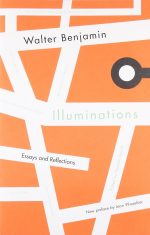 Walter Benjamin (1969)
Studies on contemporary art and culture by one of the most original, critical and analytical minds of this century. Illuminations includes Benjamin’s views on Kafka, with whom he felt the closest personal affinity, his studies on Baudelaire and Proust (both of whom he translated), his essays on Leskov and on Brecht’s Epic Theater. Also included are his penetrating study on “The Work of Art in the Age of Mechanical Reproduction,” an illuminating discussion of translation as a literary mode, and his thesis on the philosophy of history. Hannah Arendt selected the essays for this volume and prefaces them with a substantial, admirably informed introduction that presents Benjamin’s personality and intellectual development, as well as his work and his life in dark times.
Posted in art, culture, history, language, media, philosophy, photography
The Ruin of Representation in Modernist Art and Texts
 Jo Anna Isaak (1986)
An investigation of the relationship of painting and literature, and the emergence of abstraction in art and writing, discussing figures such as James Joyce, Picasso, Gertrude Stein, and Wyndham Lewis.
Image, Music, Text
 Roland Barthes (1978)
Roland Barthes, the French critic and semiotician, was one of the most important critics and essayists of this century. His work continues to influence contemporary literary theory and cultural studies. Image-Music-Text collects Barthes’s best writings on photography and the cinema, as well as fascinating articles on the relationship between images and sound. Two of Barthes’s most important essays, “Introduction to the Structural Analysis of Narrative” and “The Death of the Author” are also included in this fine anthology, an excellent introduction to his thought.
The Anti-Aesthetic: Essays on Postmodern Culture
 Edited by Hal Foster (1993)
A handsome new edition of the seminal collection of late-twentieth-century cultural criticism. Named a Best Book of the Year by the Village Voice and considered a bible of contemporary cultural criticism, The Anti-Aesthetic is reissued now in a handsome new paperback edition. For the past twenty years, Hal Foster has pushed the boundaries of cultural criticism, establishing a vantage point from which the seemingly disparate agendas of artists, patrons, and critics have a telling coherence. In The Anti-Aesthetic, preeminent critics such as Jean Baudrillard, Rosalind Krauss, Fredric Jameson, and Edward Said consider the full range of postmodern cultural production, from the writing of John Cage, to Cindy Sherman’s film stills, to Barbara Kruger’s collages. With a redesigned cover and a new afterword that situates the book in relation to contemporary criticism, The Anti-Aesthetic provides a strong introduction for newcomers and a point of reference for those already engaged in discussions of postmodern art, culture, and criticism.
Digital Mantras: The Language of Abstract and Virtual Worlds
 Steven Holtzman (1995)
Holtzman, who holds a doctorate in computer science, provides a highly stimulating discussion of the integration of music, art, and language with recent trends in computer technology. He traces the evolution of formal abstract structures as they exist in the music of Schoenberg and Boulez, the art of Kandinsky, and the language grammars of Chomsky. Since computers have the capability to manipulate structures, the author contends that we have reached new frontiers of unexplored artistic creativity; he foresees new worlds of creative expression-that is, “virtual worlds.” This text wisely addresses the issues of dissonance in electronic music and human emotion and understanding in the creative process. Holtzman’s journey into “virtual reality,” sprinkled with a touch of Indian mysticism, is a totally intelligible, enjoyable venture.
Posted in art, history, language, media, music, philosophy, science, technology
Mr. Wilson’s Cabinet Of Wonder: Pronged Ants, Horned Humans, Mice on Toast, and Other Marvels of Jurassic Technology
 Lawrence Weschler (1995)
In the non-Aristotelian, non-Euclidean, non-Newtonian space between the walls of the Museum of Jurassic Technology in Los Angeles exist bats that can fly through lead barriers, spore-ingesting pronged ants, elaborate theories of memory, and a host of other off-kilter scientific oddities that challenge the traditional notions of truth and fiction. Lawrence Weschler’s book, expanded from an article for Harper’s, is, at turns, a tour of the museum, a profile of its founder and curator, David Wilson, and a meditation on the role of imagination and authority in all museums, in science and in life. Mr. Wilson’s Cabinet of Wonder is an exquisite piece of “magic realist nonfiction” that will prove utterly captivating.
Posted in art, biography, consciousness, exhibition, philosophy, science
Forest Of Signs: Art in the Crisis of Representation
 Ann Goldstein, Mary Jane Jacob, Anne Rorimer, Howard Singerman, and Richard Koshalek (1989)
The thread of representation ties together the work of the 30 artists included in the book, encompassing such issues as allegory, appropriation, and commodification, the role of the artist, and the functions of authorship and originality in vesting meaning in art. Much of the work is provocative, challenging the way we look at art, the way we talk about it, where we see it, and how we buy it.
Posted in art, culture, exhibition, history, language, photography, semiotics, theory