
Category Archives: art
African Fractals: Modern Computing and Indigenous Design
 Ron Eglash (1999)
Drawing on interviews with African designers, artists, and scientists, Ron Eglash investigates fractals in African architecture, traditional hairstyling, textiles, sculpture, painting, carving, metalwork, religion, games, practical craft, quantitative techniques, and symbolic systems. He also examines the political and social implications of the existence of African fractal geometry. His book makes a unique contribution to the study of mathematics, African culture, anthropology, and computer simulations.
Fluxus Forms: Scores, Multiples, and the Eternal Network
 Natilee Harren (2020)
While today the Fluxus collective is recognized for its radical neo-avant-garde works of performance, publishing, and relational art and its experimental, interdisciplinary approach, it was not taken seriously in its own time. With Fluxus Forms, Natilee Harren captures the magnetic energy of Fluxus activities and collaborations that emerged at the intersections of art, music, performance, and literature. The book offers insight into the nature of art in the 1960s as it traces the international development of the collective’s unique intermedia works — including event scores and Fluxbox multiples — that irreversibly expanded the boundaries of contemporary art.
Sculpting in Time

Andrei Tarkovsky (1985)
In Sculpting in Time, Andrey Tarkovsky has left his artistic testament, a remarkable revelation of both his life and work. He sets down his thoughts and his memories, revealing for the first time the original inspirations for his extraordinary films.
Käthe Kollwitz: Prints, Process, Politics
 Edited by Louis Marchesano (2020)
German printmaker Käthe Kollwitz (1867–1945) is known for her unapologetic social and political imagery; her representations of grief, suffering, and struggle; and her equivocal ideas about artistic and political labels. This volume explores Kollwitz’s obsessive printmaking experiments with the evolution of her images, and assesses the unusually rich progressions of preparatory drawings, proofs, and rejected images behind Kollwitz’s compositions of struggling workers, rebellious peasants, and grieving
mothers.
Posted in art, biography, exhibition, politics, printmaking
The Print Before Photography: An Introduction to European Printmaking 1550 – 1820

Antony Griffiths (2016)
A landmark publication — beautifully illustrated with over 300 prints from the British Museum’s renowned collection — which traces the history of printmaking from its earliest days until the arrival of photography. Copperplate printmaking, developed alongside Gutenberg’s invention of moveable type, was a huge business employing thousands of people, and dominating image production for nearly four centuries across the whole of Europe. Its techniques and influence remained very stable until the nineteenth century, when this world was displaced by new technologies, of which photography was by far the most important. Print Before Photography examines the unrivaled importance of printmaking in its golden age, illustrated through the British Museum’s outstanding collection of prints. This unique and significant book is destined to be a leading reference in print scholarship, and will be of interest to anyone with an interest in this era of art history.
Posted in art, history, media, printmaking, technology
The Women of Atelier 17: Modernist Printmaking in Midcentury New York
 Christina Weyl (2019)
In this important book Christina Weyl takes us into the experimental New York print studio Atelier 17 and highlights the women whose work there advanced both modernism and feminism in the 1940s and 1950s. Weyl focuses on eight artists — Louise Bourgeois, Minna Citron, Worden Day, Dorothy Dehner, Sue Fuller, Alice Trumbull Mason, Louise Nevelson, and Anne Ryan—who bent the technical rules of printmaking and blazed new aesthetic terrain with their etchings, engravings, and woodcuts. She reveals how Atelier 17 operated as an uncommonly egalitarian laboratory for revolutionizing print technique, style, and scale. It facilitated women artists’ engagement with modernist styles, providing a forum for extraordinary achievements that shaped postwar sculpture, fiber art, neo-Dadaism, and the Pattern and Decoration movement. Atelier 17 fostered solidarity among women pursuing modernist forms of expression, providing inspiration for feminist collective action in the 1960s and 1970s. The Women of Atelier 17 also identifies for the first time nearly 100 women, many previously unknown, who worked at the studio, and provides incisive illustrated biographies of selected artists.
Biographical Supplement: https://atelier17.christinaweyl.com
Posted in art, biography, education, printmaking
Nature: Collaborations in Design
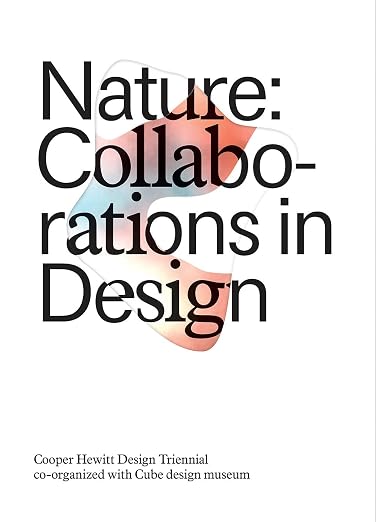 Andrea Lipps, Matilda McQuaid, Caitlin Condell, Gène Bertrand
Designers today are striving to transform our relationship with the natural world. Although humans are intrinsically linked to nature, our actions have frayed this relationship, forcing designers to think more intentionally and to consider the impact of every design decision, from an artifact’s manufacture and use to its obsolescence. As a result, designers are aligning with biologists, engineers, agriculturists, environmentalists and many other specialists to design a more harmonious and regenerative future. Based on these new partnerships, designers are asking different questions and anticipating future challenges, which not only change the design process, but also what design means.
Nature: Collaborations in Design ― companion to an exhibition titled Nature ― Cooper Hewitt Design Triennial, Co-organized with Cube design museum―includes over 65 international projects from the fields of architecture, product design, landscape design, fashion, interactive and communication design, and material research. More than 300 compelling and exquisite photographs, illustrations and content from data visualizations illustrate seven essays, which explain and explore designers’ strategies around understanding, simulating, salvaging, facilitating, augmenting, remediating and nurturing nature. Four conversations between scientists and designers delve into topics related to synthetic biology, scientific versus design lexicon and recent shifts in the meaning of nature with a glossary illuminating scientific, technological and theoretical concepts and processes invoked by the designers.
Posted in architecture, art, design, environment, exhibition, science, technology
Louise Bourgeois: An Unfolding Portrait

Deborah Wye (2017)
Published in conjunction with an exhibition at The Museum of Modern Art, this catalog presents more than 270 prints and books, organized thematically, and includes an essay that traces Bourgeois’ involvement with these mediums within the broader developments of her life and career. It also emphasizes the collaborative relationships that were so fundamental to these endeavors. Included are interviews with Bourgeois’ longtime assistant, a printer she worked with side-by-side at her home/studio on 20th Street in New York and the publisher who, in the last decade of her life, encouraged her to experiment with innovative prints that broke the traditional boundaries of the medium. The volume is rounded out with a chronology and bibliography that focus on prints and illustrated books while also providing general background on Bourgeois’ life and art.
Link to MoMA online archive: Louise Bourgeois: The Complete Prints & Books
Posted in art, biography, exhibition, interview, printmaking
Something to Take My Place: The Art of Lonnie Holley
 Edited by Mark Sloan (2016)
Lonnie Holley (born 1950), acclaimed by The New York Times as “the Insider’s Outsider,” is best known for his assemblage sculptures incorporating natural and man-made materials, often cast off or discarded; he has recently also begun to make music, through the Dust-to-Digital label. Legendary for his environmental assemblage that spread over two acres of his property in Birmingham, Alabama―now destroyed―Holley scavenges and repurposes found objects in the service of a personal philosophy of renewal and rejuvenation. This is the first monograph on Holley’s work in more than a decade. Illustrated with reproductions of more than 70 of Holley’s sculptures, it provides a comprehensive overview of Holley’s art, life and philosophy, with essays by Mark Sloan, Leslie Umberger, Bernard L. Herman and an “as-told-to” autobiography recorded by noted oral historian Theodore Rosengarten.
Posted in art, biography, culture, exhibition, music
Art for Every Home: Associated American Artists, 1934-2000
 Edited by Elizabeth G. Seaton and Jane Myers (2015)
This highly original study offers the first comprehensive, critical overview of a company that expanded the audience for American prints, ceramics, and textiles throughout the 20th century.
Link to Illustrated Index of Associated American Artists Prints, Ceramics, and Textile Designs: AAA Index
Posted in art, culture, design, exhibition, history, printmaking