
Category Archives: design
Ray Johnson: Correspondences
 Donna De Salvo and Catherine Gudis (1999)
In 1995, the resolutely reclusive Ray Johnson reemerged into the spotlight when he died in a mysterious and spectacular way, leading to the discovery of thousands of works of art in his house. Drawing upon this vast trove, Donna De Salvo, the Wexner Center’s Curator at Large, has organized Ray Johnson: Correspondences, the first comprehensive exhibition to be mounted (with the complete cooperation of the artist’s estate).
Like Rauschenberg, Cy Twombly, Jasper Johns, and later Andy Warhol and Jim Rosenquist, Johnson combined the signs and symbols of contemporary culture with the lessons of abstraction to develop a new lexicon of forms. A pioneer in the use of ‘found’ images and techniques of mechanical reproduction, Johnson created in 1955 what may have been the first informal happening.
Johnson first created ‘mail art’ in the fifties. These were part collage, part manifesto, part parody; he often instructed recipients to ‘add to’, ‘return to’, or ‘send to’, spawning an interactive art form, a continuous happening, that pre-figured electronic mail. Johnson was the nerve center of this pre-digital netscape that spread around the nation and, eventually, the world, which continues to flourish today.
By the eighties, Johnson was a legend in the artistic community. Ray Johnson: correspondences, offers the first opportunity for in-depth examination of the work of an artist who reflected and dissected many of the aesthetic, cultural, and theoretical preoccupations of the last forty years; a figure whose impact and influence will finally be made known.
Posted in art, biography, culture, design, exhibition, language, media, semiotics, typography
Modern Threads: Fashion and Art by Mariska Karasz
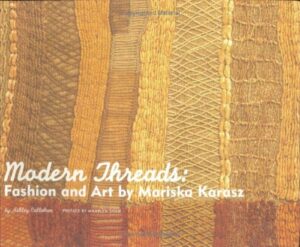 Ashley Callahan (2007)
This fully illustrated book on fashion designer and fiber artist Mariska Karasz (1898-1960) accompanies the exhibition of the same name at the Georgia Museum of Art from January 20 to April 15, 2007. It is divided into three major sections, one focusing on her fashion design for women, one on her fashion design for children, and one on her embroidered wall hangings. With many full-color images representing all three of these categories, it is the most comprehensive work published on Karasz.
Posted in art, biography, design, exhibition, history
Critical Vehicles: Writings, Projects, Interviews
 Krzysztof Wodiczko (1999)
Krzysztof Wodiczko, one of the most original avant-garde artists of our time, is perhaps best known for the politically charged images he has projected onto buildings and monuments from New York to Warsaw–images of rockets projected onto triumphal arches, the image of handcuffed wrists projected onto a courthouse facade, images of homeless people in bandages and wheelchairs projected onto statues in a park from which they had been evicted. Critical Vehicles is the first book in English to collect Wodiczko’s own writings on his projects. Wodiczko has stated that his principal artistic concern is the displacement of traditional notions of community and identity in the face of rapidly expanding technologies and cultural miscommunication. In these writings he addresses such issues as urbanism, homelessness, immigration, alienation, and the plight of refugees. Fusing wit and sophisticated political insight, he offers the artistic means to help heal the damages of uprootedness and other contemporary troubles.
Posted in architecture, art, culture, design, interview, media, philosophy, politics, technology
Inside Design Now: The National Design Triennial
 Donald Albrecht, Ellen Lupton, Mitchell Owens, and Susan Yelavich (2003)
Inside Design Now takes the pulse of American design in the new millennium, providing a fascinating tour of cutting-edge trends in architecture, interiors, landscape, fashion, graphics, and new media.
Featuring eighty emerging and established designers – including 2 x 4, Mike Mills, Peter Eisenman, Fuse Project, Tod Machover, Paula Scher, Jennifer Siegal, and Isaac Mizrahi – Inside Design Now illustrates the most innovative and provocative thinking in design today. Each designer’s work is presented with a double-page spread and a series of full-color images. Essays explore the role of the designer in today’s culture, contemporary ideas of beauty and functionality, and what the future holds in the realm of design. Sensuous materials, lush patterns, and exquisite details come together with new technologies, pop imagery, and fresh approaches to scale, color, and construction in the works reproduced in this volume.
Posted in architecture, art, culture, design, exhibition, media, technology, typography
Obey the Giant: Life in the Image World
 Rick Poyner (2001)
Design critic Rick Poynor explores the thinking behind contemporary visual culture – intriguing and fascinating appraisal. In the twenty-first century, commerce and culture are ever more closely entwined. This new collection of essays by design critic Rick Poynor takes a searching look at visual culture to discover the reality beneath the ultra-seductive surfaces. Poynor explores the thinking behind the emerging resistance to commercial rhetoric among designers, and offers critical insights into the changing dialogue between advertising and design. Other essays address the topics of visual journalism; brands as religion; the new solipsism; graphic memes; the pleasures of imperfect design; and the poverty of “cool”. Around the world, many are now waking up to the dominance of huge corporations – invariably expressed by visual means. This pointed and provocative counterblast arrives at a moment when critical responses are vital if this mono-culture is to be challenged. It offers inspirational evidence of alternative ways of engaging with design, and it will appeal to any reader with a questioning interest in design, advertising, cultural studies, media studies, and the visual arts.
Saarinen House and Garden: A Total Work of Art
 Edited by Gregory Wittkopp and Diana Balmori (1995)
Certainly one of the most overlooked works of modern architecture, the Saarinen house, which this book documents in splendid detail, is perhaps the crowning work of Finnish architect Eliel Saarinen during his years at Cranbrook. Thanks to the recent restoration of the house and garden, we can now see his vision of TOTAL design; from the flatware to the tapestries to the furniture to the door handle to the landscape.
Posted in architecture, art, Cranbrook, design, history
Cranbrook Design: The New Discourse
 Katherine and Michael McCoy (1990)
A book that documents Cranbrook’s Design Department faculty, student, and alumni work from 1980-1990. Although not defined by a style, the Cranbrook design philosophy has been influential in product, graphic and furniture design. Products have been treated as sensual objects to be interpreted. “We’ve tried to recognize that products carry the mythology of the culture,” said Michael McCoy, chairman of the design department with his wife, Katherine.
Design in America: The Cranbrook Vision, 1925-1950
 Edited by Robert Clark and Andrea Belloli (1984)
As Neil Harris explains in one of the book’s most interesting essays, Cranbrook derived from the arts and crafts movement that started in mid- 19th-century England as a reaction against shoddy industrial output and that, spreading speedily through northern Europe, resulted in the foundation of several schools aimed at reforming design by relating it more to art and life.
The Cranbrook complex, consisting of a church, schools for children, residences, studios and workshops, took about nine years to complete, by which time it had become – not an art school, but, in the words of the architect Eliel Saarinen, ”a working place for creative arts.” The emphasis, says Robert Judson Clark in his essay, was more on ”place, people and experience than on curriculum and methods.” Still, during World War II, this shifted to more orthodox concerns – credits, degrees and specific courses in, for instance, industrial design.
The influence of the Saarinens diminishes as the first generation of Cranbrook students comes of age, in the 1940s. The students include Ray and Charles Eames, represented by architecture and furniture; Florence Knoll, with interiors, and Harry Bertoia, with welded-metal sculptures.
Whereishere
 Scott and Laurie Makela (1998)
What is driving communication and what are the real challenges facing designers today? Whereishere presents a radical new take on both these issues, breaks from the orthodox approach to understanding two dimensional design. Leading graphic design studios are represented including Bruce Mau and Cranbrook Academy of Art.
Posted in art, Cranbrook, design, education, media, photography, typography
Mixing Messages
 Ellen Lupton (1996)
How do we disseminate information? And what does it look like? Ellen Kupton answers that in her new book, Mixing Messages: Graphic Design in Contemporary Culture. Lupton looks at the mission of design through discussions about publishing, signage, typography, corporate identity and the use of design in public places. Mixing Messages will fascinate fans of design, culture or social history.