
Category Archives: culture
Apocalypse Culture
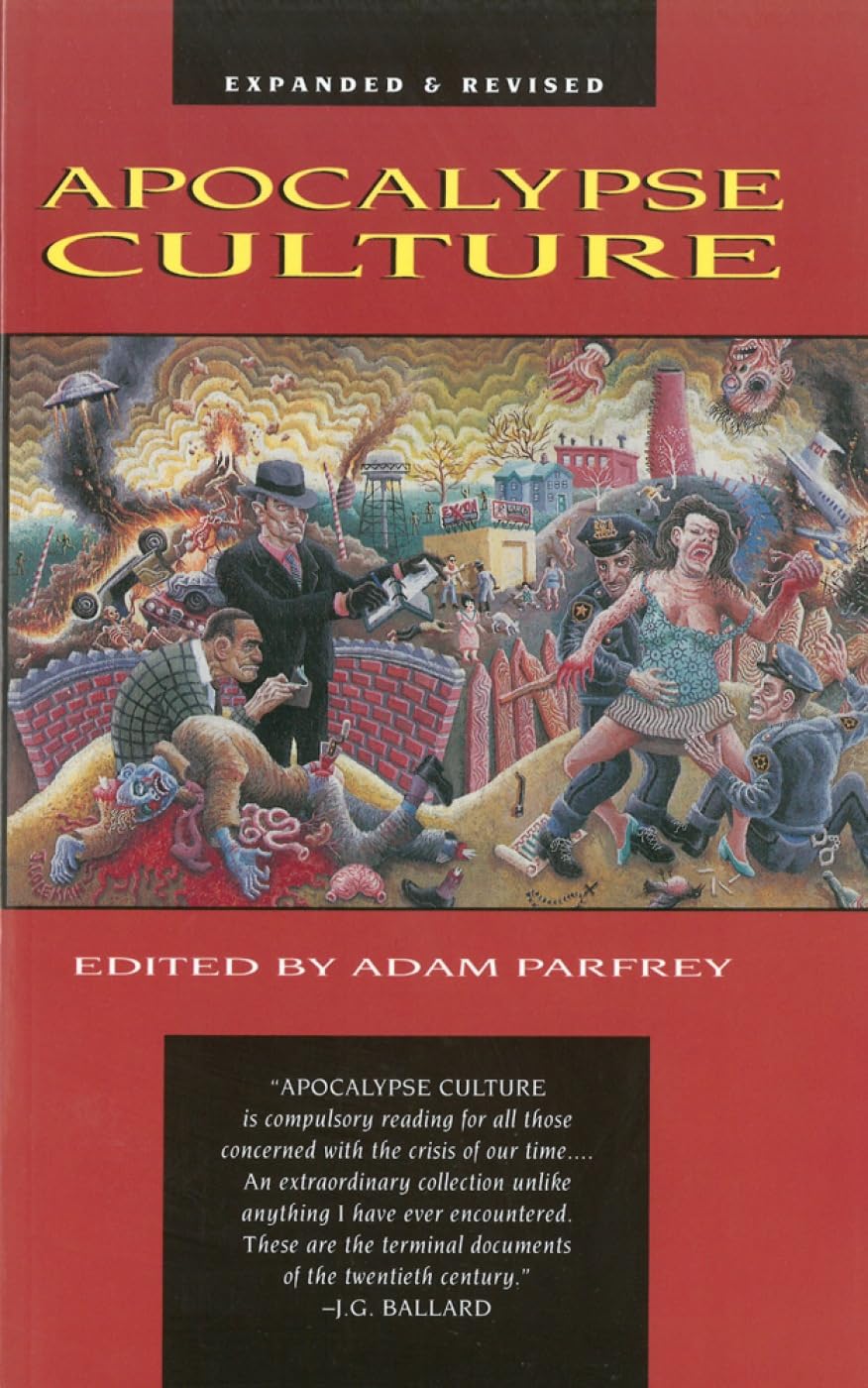 Edited by Adam Parfrey (1987)
“Apocalypse Culture is compulsory reading for all those concerned with the crisis of our times. An extraordinary collection unlike anything I have ever encountered. These are the terminal documents of the twentieth century.” -J.G. Ballard
Posted in culture, myth, philosophy
The Chalice and the Blade
 Riane Eisler (1994)
Women played leading roles in the first Christian communities; Jesus’ teachings had a feminist bent; ancient Hebrews worshipped the prehistoric goddess-mother well into monarchic times; and Nazis, with their system of male dominance, were a direct throwback to the Indo-European or Aryan invaders whom they crudely imitated. These controversial ideas and findings suggest the thrust of Eisler’s highly readable synthesis. She convincingly documents the global shift from egalitarian to patriarchal societies, interweaving new archeological evidence and feminist scholarship. In her scenario, as women, once venerated, were degraded to pawns controlled by men, social cooperation gave way to reliance on violence, hierarchy and authoritarianism.
Meditations On a Hobby Horse and Other Essays On the Theory of Art
 E.H. Gombrich (1963)
Prompted by modern critical discussions, the fourteen papers, lectures and articles assembled in this volume revolve around issues raised by twentieth-century art and theory. Taking abstraction and expression as his main themes, Professor Gombrich’s essays encompass the whole of the history of art, and include major articles on the social history of art, visual metaphor, tradition and expression, and psychoanalysis.
Art Subjects
 Howard Singerman (1999)
Nearly every artist under the age of fifty in the United States today has a Master of Fine Arts degree. Howard Singerman’s thoughtful study is the first to place that degree in its proper historical framework and ideological context. Arguing that where artists are trained makes a difference in the forms and meanings they produce, he shows how the university, with its disciplined organization of knowledge and demand for language, played a critical role in the production of modernism in the visual arts. Now it is shaping what we call postmodernism: like postmodernist art, the graduate university stresses theory and research over manual skills and traditional techniques of representation.
Singerman, who holds an M.F.A. in sculpture as well as a Ph.D. in Visual and Cultural Studies, is interested in the question of the artist as a “professional” and what that word means for and about the fashioning of artists. He begins by examining the first campus-based art schools in the 1870s and goes on to consider the structuring role of women art educators and women students; the shift from the “fine arts” to the “visual arts”; the fundamental grammar of art laid down in the schoolroom; and the development of professional art training in the American university. Singerman’s book reveals the ways we have conceived of art in the past hundred years and have institutionalized that conception as atelier activity, as craft, and finally as theory and performance.
Overlay
 Lucy Lippard (1983)
Overlay is Lucy Lippard’s classic book on contemporary art and its connection to prehistoric sites and symbols. Viewed by critics, artists, art historians, and students as the essential text on how prehistoric images have been “overlayed” onto contemporary art by today’s artists, Overlay is for anyone interested in the possibility of reintegrating art into the fabric of society as a whole, as in prehistoric times.
Literary Theory
 Terry Eagleton (1983/1996)
This classic work, whose first edition sold more than 120,000 copies, is designed to cover all of the major movements in literary studies in this century. The second edition contains a major new survey chapter that addresses developments since the book’s original publication in 1983, including feminist theory, postmodernism, poststructuralism-what is broadly referred to as cultural theory.
Posted in culture, language, philosophy, semiotics, theory
The Book of Probes
 Marshall McLuhan (2003)
Until now, no book has explored the full expanse of Marshall McLuhan’s thinking. Here we have assembled alongside his most prescient aphorisms excerpts from the full range of his astounding life’s work. One revolutionary book distills the wisdom and wit of the man who explained to us the “the medium is the message” and that we are “now living in a global village”, that “privacy invasion is now our most important knowledge industry” and that “obsolescence is the moment of superabundance”. Art director and designer David Carson presents McLuhan’s images with new insight, and has built a work of art that is reminiscent of those lasting works permanently commissioned and interpreted by new generations.
Posted in culture, design, media, philosophy, technology, theory
The Paul Virilio Reader
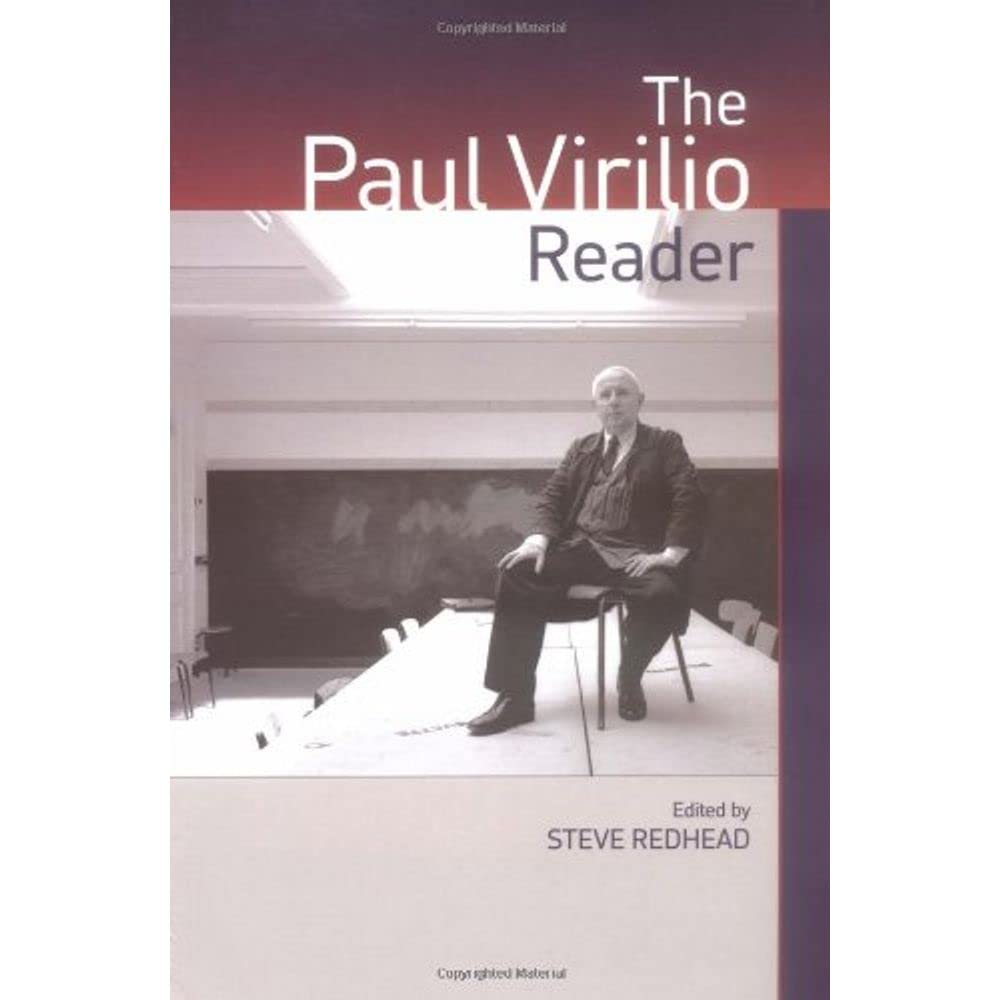 Edited by Steve Redhead (2004)
The Paul Virilio Reader collects for the first time English extracts reflecting the entire range of Virilio’s diverse career. The book’s introduction demonstrates that Virilio has produced an important — if controversial — “theory at the speed of light” that uncannily illuminates the impact of new information and communications technologies in a world that collapses time and distance as never before. The inventor of “dromology,” which views speed as a defining concept for contemporary civilization, Virilio is noted for his proclamation that the logic of ever-increasing acceleration lies at the heart of the organization and transformation of the contemporary world.
Posted in architecture, culture, philosophy, technology, theory
Snap to Grid: A User’s Guide to Digital Arts, Media, and Cultures
 Peter Lunenfeld (2000)
In Snap to Grid, an idiosyncratic guide to the interactive, telematic era, Peter Lunenfeld maps out the trajectories that digital technologies have traced upon our cultural imaginary. His clear-eyed evaluation of new media includes an impassioned discussion–informed by the discourses of technology, aesthetics, and cultural theory–of the digital artists, designers, and makers who matter most. “Snap to grid” is a command that instructs the computer to take hand-drawn lines and plot them precisely in Cartesian space. Users regularly disable this function the moment they open an application because the gains in predictability and accuracy are balanced against the losses of ambiguity and expressiveness. Lunenfeld uses “snap to grid” as a metaphor for how we manipulate and think about the electronic culture that enfolds us. In this book he snaps his seduction by the machine to the grid of critical thinking.
Posted in art, culture, media, technology, theory