
Category Archives: technology
Snap to Grid: A User’s Guide to Digital Arts, Media, and Cultures
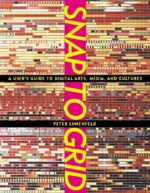 Peter Lunenfeld (2000)
In Snap to Grid, an idiosyncratic guide to the interactive, telematic era, Peter Lunenfeld maps out the trajectories that digital technologies have traced upon our cultural imaginary. His clear-eyed evaluation of new media includes an impassioned discussion–informed by the discourses of technology, aesthetics, and cultural theory–of the digital artists, designers, and makers who matter most. “Snap to grid” is a command that instructs the computer to take hand-drawn lines and plot them precisely in Cartesian space. Users regularly disable this function the moment they open an application because the gains in predictability and accuracy are balanced against the losses of ambiguity and expressiveness. Lunenfeld uses “snap to grid” as a metaphor for how we manipulate and think about the electronic culture that enfolds us. In this book he snaps his seduction by the machine to the grid of critical thinking.
Posted in art, culture, media, technology, theory
Multimedia: From Wagner to Virtual Reality
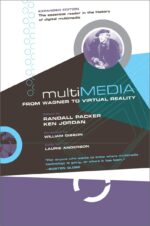 Edited by Randall Packer and Ken Jordan (expanded edition, 2002)
Readers interested in the history of multimedia should be enthralled by this collection of hard-to-find essays. “Outline of the Artwork of the Future,” for instance, was first published in 1849, and its author was the great German composer Richard Wagner, who envisioned a new kind of stage drama that united music, visual effects, poetry, and dance. Skip forward seven decades, and here’s 1924’s “Theater, Circus, Variety,” by Laszlo Moholy-Nagy, one of the foremost practitioners of the Bauhaus school of art. His elaboration of Wagner’s ideas incorporated the revolutionary idea of removing the so-called fourth wall and involving the audience in the play. Similarly, these essays trace the evolution of electronic media, film, and books (William Burroughs’ 1964 piece, “The Future of the Novel,” is itself worth the price of admission). A remarkable blending of past and present, these essays remind us that today’s wondrous inventions didn’t just spring into existence out of nothingness.
Posted in art, history, media, philosophy, science, technology, theory
The Language of New Media
 Lev Manovich (2001)
In this book Lev Manovich offers the first systematic and rigorous theory of new media. He places new media within the histories of visual and media cultures of the last few centuries. He discusses new media’s reliance on conventions of old media, such as the rectangular frame and mobile camera, and shows how new media works create the illusion of reality, address the viewer, and represent space. He also analyzes categories and forms unique to new media, such as interface and database.
Manovich uses concepts from film theory, art history, literary theory, and computer science and also develops new theoretical constructs, such as cultural interface, spatial montage, and cinegratography. The theory and history of cinema play a particularly important role in the book. Among other topics, Manovich discusses parallels between the histories of cinema and of new media, digital cinema, screen and montage in cinema and in new media, and historical ties between avant-garde film and new media.
Posted in art, cinema, media, technology, theory