
Category Archives: technology
Being There: Putting Brain, Body, and World Together Again
 Andy Clark (1996)
Brain, body, and world are united in a complex dance of circular causation and extended computational activity. In Being There, Andy Clark weaves these several threads into a pleasing whole and goes on to address foundational questions concerning the new tools and techniques needed to make sense of the emerging sciences of the embodied mind. Clark brings together ideas and techniques from robotics, neuroscience, infant psychology, and artificial intelligence. He addresses a broad range of adaptive behaviors, from cockroach locomotion to the role of linguistic artifacts in higher-level thought.
Posted in consciousness, language, science, technology
Digital Mantras: The Language of Abstract and Virtual Worlds
 Steven Holtzman (1995)
Holtzman, who holds a doctorate in computer science, provides a highly stimulating discussion of the integration of music, art, and language with recent trends in computer technology. He traces the evolution of formal abstract structures as they exist in the music of Schoenberg and Boulez, the art of Kandinsky, and the language grammars of Chomsky. Since computers have the capability to manipulate structures, the author contends that we have reached new frontiers of unexplored artistic creativity; he foresees new worlds of creative expression-that is, “virtual worlds.” This text wisely addresses the issues of dissonance in electronic music and human emotion and understanding in the creative process. Holtzman’s journey into “virtual reality,” sprinkled with a touch of Indian mysticism, is a totally intelligible, enjoyable venture.
Posted in art, history, language, media, music, philosophy, science, technology
Remediation: Understanding New Media
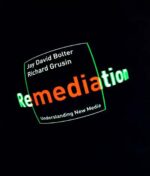 Jay David Bolter and Richard Grusin (2000)
Media critics remain captivated by the modernist myth of the new: they assume that digital technologies such as the World Wide Web, virtual reality, and computer graphics must divorce themselves from earlier media for a new set of aesthetic and cultural principles. In this richly illustrated study, Jay David Bolter and Richard Grusin offer a theory of mediation for our digital age that challenges this assumption. They argue that new visual media achieve their cultural significance precisely by paying homage to, rivaling, and refashioning such earlier media as perspective painting, photography, film, and television. They call this process of refashioning “remediation,” and they note that earlier media have also refashioned one another: photography remediated painting, film remediated stage production and photography, and television remediated film, vaudeville, and radio.
Posted in art, media, technology, theory
Design Culture Now
 By Ellen Lupton and Donald Albrecht (2000)
This is the first-ever survey of American design that cuts across the four disciplines of architecture, product design, graphic design, and new media. Put together by the National Design Museum surveys the up-to-the-minute trends in American design from architecture to product and graphic design to new media. This comprehensive survey catalogs the best in architecture, interiors, environments, landscapes, products, furniture, fashion, objects, typefaces, posters, publications, film and TV graphics, and interactive media from the last three years.
Posted in architecture, art, culture, design, exhibition, media, technology, typography
Being & Time: The Emergence of Video Projection
 Marc Mayer (1996)
One of the first catalogues to examine seriously the growing use of video in contemporary art practice. It features the work of established masters of the field such as Gary Hill, Bruce Nauman and Bill Viola as well as Diana Thater and Willie Doherty.
Posted in art, cinema, exhibition, history, media, technology
Telematic Embrace: Visionary Theories of Art, Technology, and Consciousness by Roy Ascott
 Edited by Edward Shanken (2003)
Long before e-mail and the Internet permeated society, Roy Ascott, a pioneering British artist and theorist, coined the term “telematic art” to describe the use of online computer networks as an artistic medium. In Telematic Embrace Edward A. Shanken gathers, for the first time, an impressive compilation of more than three decades of Ascott’s philosophies on aesthetics, interactivity, and the sense of self and community in the telematic world of cyberspace. This book explores Ascott’s ideas on how networked communication has shaped behavior and consciousness within and beyond the realm of what is conventionally defined as art.
Posted in art, consciousness, education, media, science, technology, theory
The Book of Probes
 Marshall McLuhan (2003)
Until now, no book has explored the full expanse of Marshall McLuhan’s thinking. Here we have assembled alongside his most prescient aphorisms excerpts from the full range of his astounding life’s work. One revolutionary book distills the wisdom and wit of the man who explained to us the “the medium is the message” and that we are “now living in a global village”, that “privacy invasion is now our most important knowledge industry” and that “obsolescence is the moment of superabundance”. Art director and designer David Carson presents McLuhan’s images with new insight, and has built a work of art that is reminiscent of those lasting works permanently commissioned and interpreted by new generations.
Posted in culture, design, media, philosophy, technology, theory
Prints and Visual Communication
 William Ivins (1969)
The sophistication of the photographic process has had two dramatic results–freeing the artist from the confines of journalistic reproductions and freeing the scientist from the unavoidable imprecision of the artist’s prints. So released, both have prospered and produced their impressive nineteenth- and twentieth-century outputs. It is this premise that William M. Ivins, Jr., elaborates in Prints and Visual Communication, a history of printmaking from the crudest wood block, through engraving and lithography, to Talbot’s discovery of the negative-positive photographic process and its far reaching consequences.
Posted in art, history, media, photography, printmaking, technology
The Paul Virilio Reader
 Edited by Steve Redhead (2004)
The Paul Virilio Reader collects for the first time English extracts reflecting the entire range of Virilio’s diverse career. The book’s introduction demonstrates that Virilio has produced an important — if controversial — “theory at the speed of light” that uncannily illuminates the impact of new information and communications technologies in a world that collapses time and distance as never before. The inventor of “dromology,” which views speed as a defining concept for contemporary civilization, Virilio is noted for his proclamation that the logic of ever-increasing acceleration lies at the heart of the organization and transformation of the contemporary world.
Posted in architecture, culture, philosophy, technology, theory
The New Media Reader
 Edited by Noah Wardrip-Fruin and Nick Montfort (2003)
This reader collects the texts, videos, and computer programs–many of them now almost impossible to find–that chronicle the history and form the foundation of the still-emerging field of new media. General introductions by Janet Murray and Lev Manovich, along with short introductions to each of the texts, place the works in their historical context and explain their significance. The texts were originally published between World War II–when digital computing, cybernetic feedback, and early notions of hypertext and the Internet first appeared–and the emergence of the World Wide Web–when they entered the mainstream of public life.
Posted in art, history, media, philosophy, science, technology, theory